

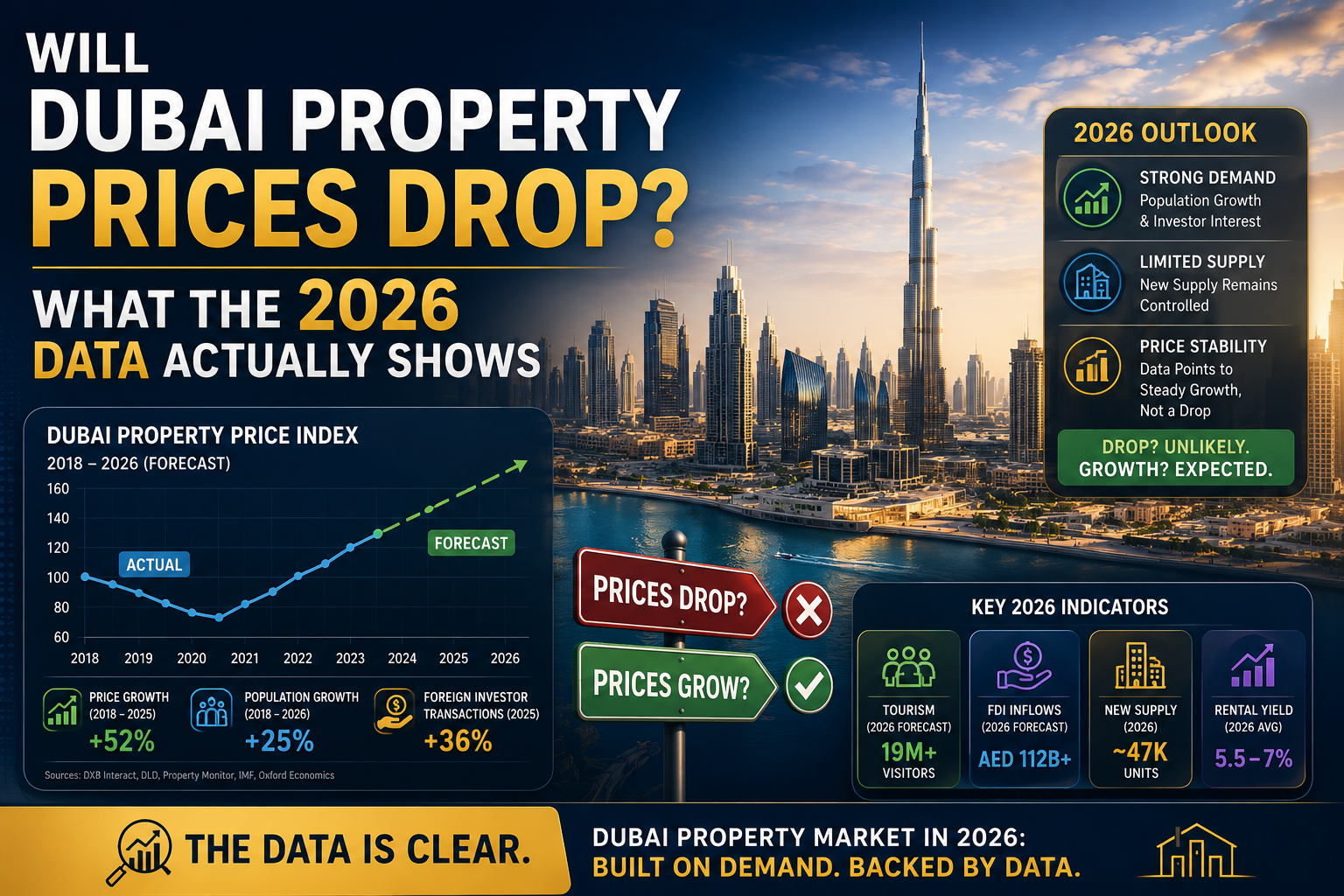
Will Dubai Property Prices Drop? What the 2026 Data Actually Shows
It’s the question dominating investor group chats, WhatsApp forwards, and property forums across the UAE right now: are Dubai’s property prices finally correcting, or is this just a pause before the next leg up? The search volume around this question has spiked hard in 2026 and for once, the data backing the debate is genuinely mixed enough to justify the noise.
Here’s a clear-eyed look at what’s actually happening, separated from the panic and the hype.
The Headline Numbers Behind the Anxiety
Start with what’s undeniable: transaction activity has cooled compared to last year’s record pace. Residential sales volume dropped roughly 13.8% in the first half of 2026 compared to the first half of 2025, with total value down around 15.7% over the same period. For a market that had been on an almost uninterrupted upward run since 2020, that’s a real deceleration enough to trigger a wave of “is this the start of a crash” searches.
Zoom out further, and the boom this cooling follows was extraordinary by any standard: Dubai’s residential prices surged by roughly 60% between 2022 and early 2025, driven by tax-free incentives, more liberal visa policies, and a sustained influx of high-net-worth buyers relocating to the emirate. Corrections after runs like that aren’t unusual the debate is really about how deep, and how long.
What’s Actually Driving the Slowdown
A few distinct forces are layered on top of each other here, and it’s worth separating them.
1. Geopolitical shock. Regional conflict earlier in 2026 rattled sentiment sharply, with reports of missile debris landing near Palm Jumeirah and strikes close to Dubai International Airport triggering a wave of social media predictions about a 30–40% crash. The actual price movement was far more modest most tracking shows prices falling somewhere in the 4-7% range from peak, not the dramatic collapse that circulated online. With a ceasefire in place, much of that acute sentiment-driven pressure has since eased.
2. Structural oversupply. This concern predates the geopolitical shock entirely. Fitch Ratings had already forecast a potential correction of 10-15% running from mid-2025 through the end of 2026, driven by an estimated 210,000 new residential units expected to enter the market roughly double the supply pace of the previous three years. When that much new inventory lands at once, it inevitably puts pressure on prices and rents in the most affected pockets.
3. Buyer caution, not buyer exit. Rather than pulling out of the market entirely, buyers appear to be taking more time, comparing communities and developers more carefully, and paying closer attention to service charges, build quality, and realistic handover timelines. That’s a shift in behaviour, not necessarily in demand.
Segment by Segment: Where the Risk Actually Sits
One of the most consistent findings across current forecasts is that any correction is expected to be uneven, not a blanket decline across the whole market.
- Mid-market and off-plan segments carry the most risk. Multiple forecasts point to potential corrections of 10-15% concentrated in areas with heavy new supply or historically speculative buying patterns.
- Prime and luxury properties are expected to hold up better. Established, land-constrained communities Downtown Dubai, Palm Jumeirah, Dubai Hills are widely expected to stay comparatively firm, supported by genuine end-user demand and limited available land for new competing supply.
- Communities with large upcoming handovers are the ones to watch most closely. If a wave of similar units completes in the same area around the same time, that’s where rental yields and resale prices are most likely to soften first.
The Case Against a Major Crash
Despite the alarming headlines, most credible forecasts stop well short of predicting a genuine downturn. The structural case for Dubai’s property market has several pillars that remain largely intact:
- No income tax and no capital gains tax on residential property, a durable advantage over most competing global markets
- Continued population growth, with well over 100,000 new residents added in recent years and further growth projected through 2026
- A currency pegged to the US dollar, which limits currency-driven volatility for international buyers
- The Golden Visa programme, which continues to convert short-term investors into long-term residents with a stake in ownership rather than speculation
One point worth flagging for anyone parsing monthly headlines: a short-term monthly decline can coexist with strong annual growth. Some analyses covering the early-2026 dip noted prices were still up double digits year-on-year even during the sharpest weeks of the sentiment-driven pullback a reminder that monthly snapshots and annual trends can tell very different stories.
What This Means If You’re Deciding Whether to Buy
A few practical takeaways, depending on where you sit:
If you’re a long-term buyer (5+ years horizon): Most forecasts suggest the underlying fundamentals population growth, tax advantages, infrastructure investment remain sound enough that short-term volatility matters less than getting the community and property quality right.
If you’re eyeing off-plan or mid-market units in high-supply areas: This is where the correction risk is genuinely concentrated. It’s worth checking how much competing supply is scheduled to complete in the same community over the next 12-24 months before committing.
If you’re considering prime or luxury property: These segments are expected to be the most resilient to any broader correction, though they also come with higher entry costs and lower rental yields, so the investment case rests more on capital preservation and appreciation than income.
If you’re trying to time the bottom: Be cautious about acting purely on short-term monthly data. Multiple sources note that windows created by sentiment-driven dips have historically closed quickly once the underlying driver (in this case, geopolitical tension) resolves.
The Bottom Line
The honest answer to “will Dubai property prices drop?” is: modestly, and unevenly, rather than dramatically. The data doesn’t support the crash narratives that circulated during the most acute period of regional tension, but it also doesn’t support pretending the market is immune to a slowdown after such a steep multi-year run. The more useful question for 2026 isn’t whether prices will fall city-wide it’s which specific communities carry oversupply risk, and which ones are insulated by genuine, durable demand. That distinction, more than any single headline number, is what should actually shape a buying decision this year.