

Dubai Metro Expansion: How New Rail Lines Are Reshaping the Property Map
For years, Dubai’s real estate story was mostly about location relative to the beach, Downtown, or DIFC. In 2026, a new variable has entered the equation: distance to the nearest metro station. As the city pushes ahead with two major rail expansions the Blue Line and the Gold Line property buyers and investors are recalculating value across dozens of communities that were once considered too far from the action.
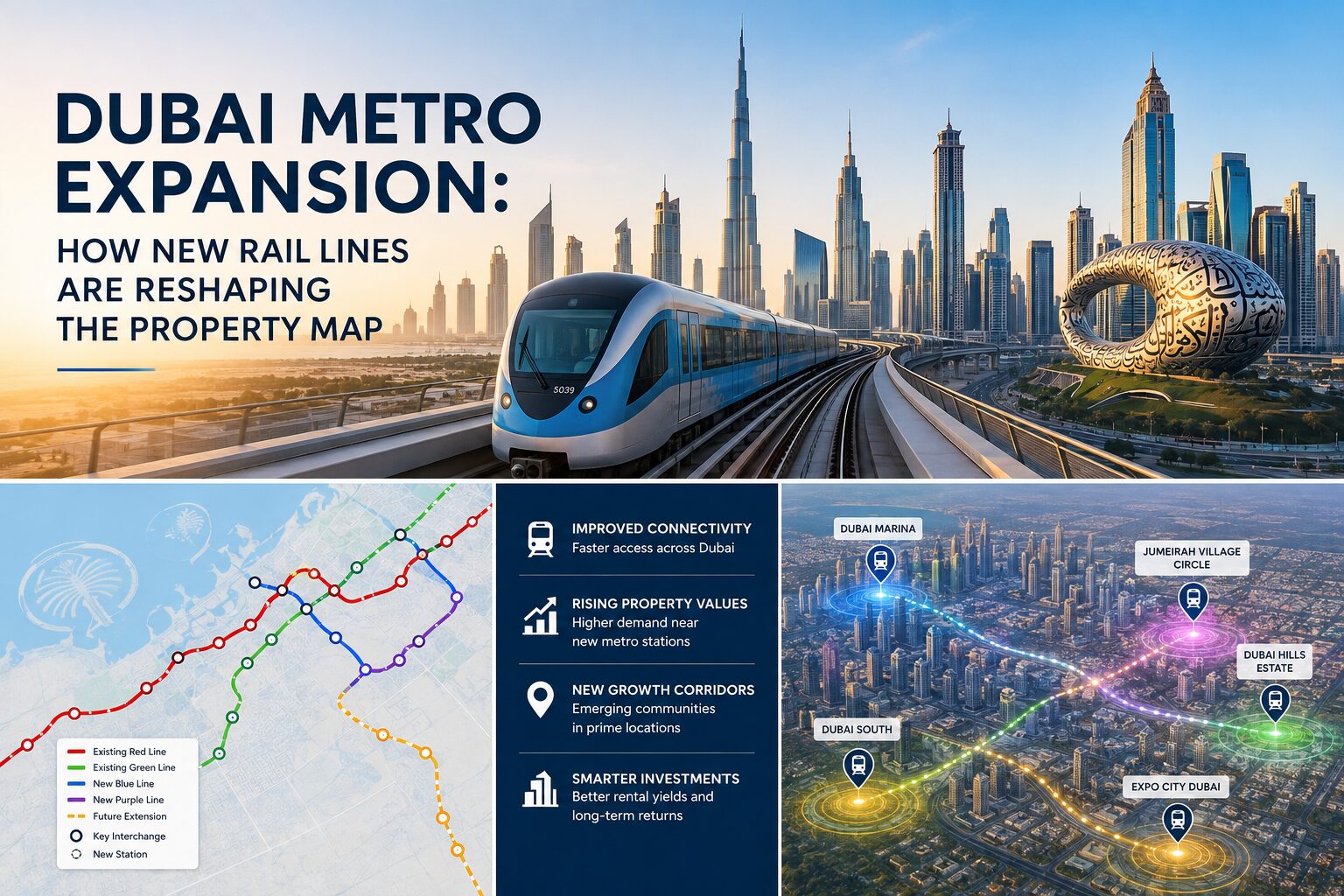
Here’s what’s actually happening, and what it means if you’re thinking about buying, renting, or investing near Dubai’s next rail corridors.
Two Major Expansions Are Underway
The Blue Line is the more advanced of the two projects. Backed by an AED 18 billion budget, construction is officially underway and on track to reach roughly 30 percent completion by the end of 2026. The line will add 14 new stations connecting Al Jaddaf to Academic City, threading through communities like Dubai Silicon Oasis, Mirdif, and Academic City areas serving more than 200,000 residents who have historically depended entirely on cars to get around. Creek Interchange, Al Jaddaf, and Centrepoint will link the new line into the existing network, with the full opening currently targeted for September 2029.
The Gold Line is the larger, more ambitious of the two a $9 billion project designed to weave together dense apartment towers, distant villa communities, and Etihad Rail hubs into a single connected system. Unlike previous lines, the Gold Line follows a non-linear route, described by one rail industry expert as effectively becoming the “spine of the city” once it links up with the existing Red and Green lines. Completion is scheduled for September 2032.
Why Metro Access Moves Property Prices
The logic here isn’t new cities from New York to Singapore have shown that rail access reshapes real estate demand but Dubai’s timeline for feeling that effect is unusually short. A few forces are driving that:
- Commute times shrink dramatically. Areas long dismissed as “car-dependent” suddenly become viable for professionals working in Downtown, DIFC, or Business Bay.
- Government-backed infrastructure builds confidence. When a project has committed public funding and a clear delivery date, investors tend to treat it as a much safer bet than speculative announcements.
- Anticipatory pricing kicks in early. Historically, the biggest price movements happen well before a line opens not after. Once a station is operational, much of that appreciation is already baked into the price.
Which Areas Stand to Gain the Most
Not every community along these new lines will benefit equally, and analysts are quick to note that the impact is selective rather than city-wide.
Along the Blue Line:
- Dubai Silicon Oasis and International City traditionally valued for affordability and rental yield, these areas are now benefiting from genuine infrastructure leverage, with some reports pointing to appreciation in the 15–25 percent range as stations near completion.
- Dubai Creek Harbour arguably the standout winner. The community will be home to what’s being billed as the world’s tallest metro station, an architectural anchor point designed by the same studio behind the Burj Khalifa. Analysts expect this to push the district from “emerging choice” toward genuine competition with Downtown Dubai, with capital value gains estimated around 15–20 percent.
- Mirdif and Academic City historically overlooked by investors due to weak connectivity, these areas are now positioned to unlock demand from tenants who previously ruled them out entirely.
Along the Gold Line:
- Business Bay as one of the system’s key interchange points, Business Bay is expected to see some of the strongest gains, since interchange stations typically capture more value than standard stops along a line.
- Dubailand and Jumeirah Golf Estates both are frequently flagged as beneficiaries of improved connectivity, particularly for buyers who want suburban-style living without sacrificing rail access to the city center.
Interestingly, analysts are quick to caveat that villa-heavy communities are less likely to see the same lift as apartment-dominated ones — space and privacy remain the primary draw for villa buyers, and proximity to a metro station matters less when a private garage is already part of the deal.
What This Means for Buyers and Investors
If there’s one consistent theme across nearly every analysis of Dubai’s metro expansion, it’s this: the window to buy before prices fully adjust is now, not after the ribbon-cutting.
A few practical takeaways:
- Interchange stations tend to outperform standard stops. If a community sits at a junction point like Business Bay on the Gold Line, or Al Jaddaf on the Blue Line it’s likely to see stronger appreciation than areas served by a single line.
- Walking distance genuinely matters. Properties within 500 meters of a confirmed station location have reportedly seen appreciation in the 20–30 percent range during 2026, well ahead of the broader market.
- Rental yields improve near stations too. Units within walking distance of a metro stop typically command rents 15–30 percent higher than comparable properties further away, along with lower vacancy rates.
- Don’t chase every announcement. Not every plotted station translates into immediate value. The strongest opportunities tend to come from confirmed access points, realistic delivery timelines, and genuine tenant demand not simply proximity to a line on a future map.
- Watch for oversupply. As certain corridors attract a wave of new development in anticipation of rail access, some analysts warn that oversupply in specific pockets could slow short-term price growth even as the broader area benefits long-term.
The Bigger Picture
Dubai’s metro expansion isn’t just a transport upgrade it’s quietly becoming one of the most important variables in how the city’s real estate market prices itself over the next several years. For buyers and investors willing to do the homework on interchange points, delivery timelines, and realistic walking distances, the current pre-completion window looks like one of the more interesting entry points in the market today.
As always with infrastructure-driven investing, the fundamentals matter more than the hype: confirmed government funding, a credible delivery date, and genuine improvement in daily commute times tend to separate the communities that will actually benefit from the ones simply riding the headlines.